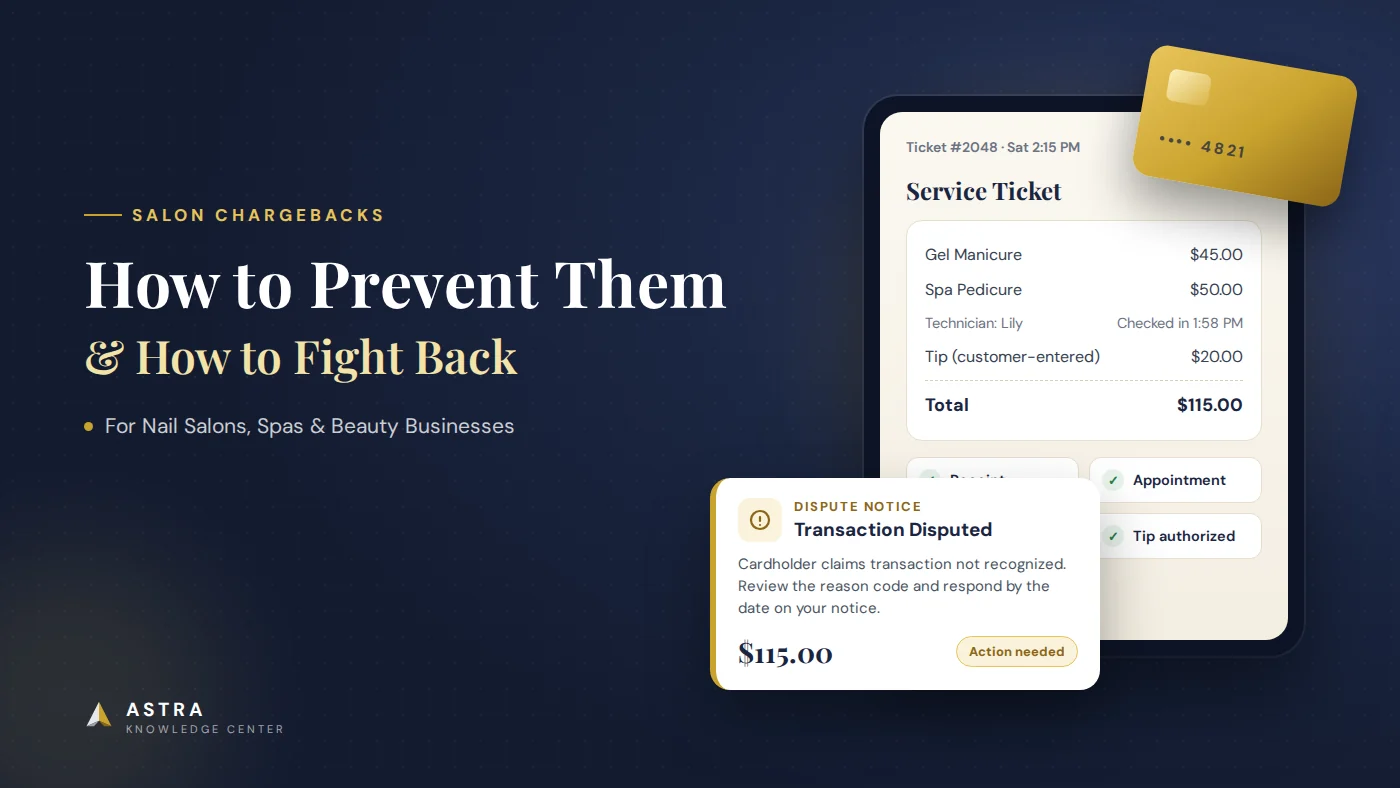
What a chargeback is, why salon clients file them, what evidence may help you respond, and the everyday habits that stop most disputes before they start.
A client comes in on a Saturday for a $120 service. She adds a tip, approves the payment, takes her receipt and leaves happy. She even books her next visit.
Three weeks later, a notice from your payment processor shows up:
The $120 may be pulled from your merchant account while the dispute is handled, and you now need to show evidence that the charge was valid.
This is a chargeback. Almost every salon, spa and barbershop that takes cards will get one sooner or later. Some are real fraud, but plenty come from confusion: a business name the client doesn’t recognize, a tip that looks wrong, or a no-show fee they forgot they agreed to.
The good news is that many salon chargebacks can be prevented, and when one does arrive, organized records give you a fair chance to respond. This guide covers both sides in plain language.
A chargeback happens when a cardholder disputes a charge with the bank that issued their card, and the bank reverses the payment while it looks into the claim. It is different from a refund. With a refund, you decide to give the money back. With a chargeback, the client goes to their bank instead of coming to you, and the money is taken back through the card system.
Four parties are involved:
The person who paid. They call their bank or use their banking app to dispute the charge.
The bank that issued the client’s card. It reviews the claim and decides whether to send it forward.
The company that handles your card payments and deposits. It notifies you and passes your response along.
Visa, Mastercard, Discover or American Express. Each sets the rules, reason codes and time limits for disputes.
You might also hear the word “dispute.” Visa uses “dispute” for the same process, and most processors use the two words interchangeably.
Not every chargeback is fraud. In a salon, many disputes come from confusion or a customer-service problem that was never resolved. Common reasons include:
The takeaway: a lot of disputes start as a question (“what is this charge?”) that turned into a bank claim because the client didn’t recognize you or couldn’t reach you. That’s why prevention matters as much as fighting back.
The details vary, but most disputes follow this general path:
On the client’s side, federal law gives credit card holders dispute rights too. The CFPB explains that for billing errors, a cardholder should send a written notice to the card company within 60 days after the charge appeared on their statement, and that disputes over the quality of goods or services may follow a different process. Card networks often allow longer windows for many dispute types. This is why a chargeback can arrive weeks after a visit.
The disputed amount is only part of the cost:
If you lose, the full disputed amount stays with the client, including any tip you may have already paid out to the technician.
Many processors charge a fee per chargeback, and some charge it whether you win or lose. The amount is set by your processor. Check your merchant agreement.
Pulling records, writing a response and following up takes owner or manager time. The service time and product are already spent.
A high dispute rate can lead your processor to add reserves, raise fees or, in serious cases, close the account.
Card networks also monitor merchants with high dispute and fraud levels. Visa’s current program, the Visa Acquirer Monitoring Program (VAMP), replaced its separate dispute and fraud monitoring programs in 2025 and looks at card-not-present transactions, such as online deposits and gift card sales. Most single-location salons are well below the volumes these programs target, but your processor may also apply its own limits. If disputes are adding up, talk to your processor early.
No. Responding takes time, and some disputes are fair. Sometimes accepting one is the right business decision.
Whatever you decide, match your evidence to the dispute reason. If the client says the charge was a duplicate, a photo of the finished nails doesn’t help. Showing that there were two separate visits, or that only one charge settled, does.
| What the client claims | Examples of evidence that speaks to it |
|---|---|
| Didn’t authorize / don’t recognize it | Card-present payment record, receipt, appointment booked under the client’s name and phone, check-in record, prior visits |
| Service not provided | Check-in time, technician assigned, itemized ticket, booking confirmation |
| Wrong amount | Itemized receipt, posted service prices, the amount the client approved, tip record |
| Duplicate charge | Proof of two separate visits or tickets, or proof the second charge was voided or refunded |
| Not as described / unhappy | Service notes, messages with the client, your refund or redo policy and any offer you made |
| Cancelled / credit not processed | Your cancellation policy, the client’s acknowledgement of it, cancellation timestamps, refund records |
Card networks group disputes into categories such as fraud, authorization, processing errors and consumer disputes, each with its own reason codes. Your notice will show which one applies.
Here is a checklist of records salons commonly use. You won’t need all of them for every case.
More documents don’t automatically make a stronger case. The best evidence directly addresses the specific reason for the dispute. A short, organized packet that answers the client’s claim is easier to review than a pile of unrelated paperwork.
A note on two items. Photos should only be taken and shared with the client’s permission and in line with your privacy practices. Previous undisputed transactions can matter in some fraud cases: for certain card-not-present fraud disputes, Visa’s Compelling Evidence 3.0 rules allow a merchant to show earlier undisputed purchases by the same customer, with specific matching data (such as IP address or device ID) and time limits. Your processor can tell you whether a dispute qualifies.
Here is how this might look in practice. The client and salon are fictional.
Three weeks later, Jennifer disputes the entire $115 as a transaction she doesn’t recognize.
The owner pulls these records:
How the owner organizes the response:
Records like these may help show that the visit happened and that Jennifer approved the payment. They do not guarantee the outcome. The issuing bank makes the final decision under the card network’s rules.
In the example above, the $20 tip was about 21% of the $95 service. Tips are a common source of salon disputes. A client may remember tipping $10 in cash, or may not have noticed a tip line that was filled in later. If the tip is wrong, or even just looks wrong, the whole transaction can be disputed.
Every receipt should make the breakdown easy to see:
Good tip habits:
A clear tip process also protects your team. See our guides to tip splitting and the salon payroll guide for how tips flow through to technician pay.
No-show and late-cancellation fees are among the most disputed salon charges, because the client is paying for a service they didn’t receive. Having a cancellation policy on your website may not be enough evidence on its own. The question in a dispute is usually whether this client saw and agreed to the policy before you charged their card.
If you charge these fees, build a clear record:
Disclose the fee clearly before it can be charged, and get the client’s acknowledgement at the moment they book or leave a card on file. Many salons find a deposit applied to the service easier to manage than charging a card later. Our guide to salon appointment deposits covers sample 24- and 48-hour policies, and how to reduce no-shows covers reminders and waitlists.
Make sure your cancellation and no-show policies, and the way you charge them, comply with applicable state and local laws, your processor’s requirements and card-network rules. Card networks have specific rules for saving a card and charging it later. Ask your processor what disclosure and consent it requires before you charge a no-show fee.
Most of the work happens long before a dispute. These thirteen habits cover the most common causes:
Many of these come down to how you run payments day to day. For background, see our guides to salon credit card processing, how to reduce credit card fees and card minimum rules. If you use a cash discount or dual pricing program, make sure the pricing is clearly posted and shown on the receipt, because a surprise surcharge is another reason clients question a charge.
This is one of the easiest chargebacks to prevent, and one of the most common.
Bright sign, friendly staff, great pedicure.
“I’ve never heard of this company.”
The text on a client’s card statement is called the billing descriptor. Often it shows the owner’s legal business name, a parent company or an abbreviation rather than the salon’s name. When a client sees an unfamiliar name weeks later, the easiest response is to tap “dispute” in their banking app.
Visa’s merchant guidance is direct: cardholders “must be able to look at their bank statements and recognize transactions that occurred at your establishment,” and it recommends checking with your acquirer that your “Doing Business As” name, city and state are correct.
When a dispute arrives three or four weeks after a visit, nobody at the front desk remembers the details. What you can show depends on what your systems recorded that day. Organized records can make responding much easier, especially when they’re connected:
When these are linked in one system, an owner can look up the client, open the visit and reconstruct what happened in a few minutes: who booked, when they arrived, who served them, what was performed, what they approved and how they paid. Without that, the same job can mean digging through a paper appointment book, a separate terminal report and a technician’s memory.
A POS system cannot guarantee that you will win a chargeback. What it can do is help keep the records you may need when a dispute arrives.
That’s the approach behind Astra POS, a salon system for nail salons, hair salons, spas, barbershops and other beauty businesses. Bookings from appointment scheduling and online booking, arrivals from check-in, client profiles and visit history, service tickets, card payments through salon credit card processing, tips and receipts are kept together, and reporting helps you review transactions over time. It won’t stop every dispute, and outcomes are always decided by the card networks and banks, but it can make the “pull the records” step faster.
By the time a dispute notice arrives, most of the outcome has already been shaped by what happened weeks earlier: whether the client recognized your name on their statement, whether the receipt showed the tip clearly, whether they agreed to your cancellation policy, and whether someone answered when they called with a question.
Prevention starts at booking and continues through checkout. A recognizable descriptor, clear receipts, documented tips, disclosed policies, quick answers to complaints and well-kept records add up to two results: fewer avoidable disputes, and better evidence when disputes do happen. Pick two or three of the prevention steps above and put them in place this week.
Astra POS helps beauty businesses keep appointments, customer records, tickets, payments and reporting organized in one place. Start on Astra Free at $0/month with no credit card required, and upgrade as you grow.
A chargeback is when a client disputes a card payment with their bank instead of asking the salon for a refund. The bank reverses the payment while it reviews the claim, and the salon can accept the dispute or respond with evidence through its payment processor.
Yes. A salon can respond through its payment processor or acquiring bank by the deadline on the dispute notice, with evidence that addresses the dispute reason. The issuing bank decides the outcome under card-network rules, so there is no guaranteed result.
It depends on the dispute reason. Common salon evidence includes itemized receipts, payment records, appointment and booking records, check-in times, the technician who performed the service, tip authorization, client messages and any policy the client agreed to. The best evidence directly answers what the client is claiming.
Yes, a cardholder can file a dispute even after receiving a service, for example by claiming it wasn’t authorized, wasn’t as described or was charged incorrectly. Records showing the visit happened and the client approved the payment may help the salon respond, but they don’t guarantee a win.
Yes. A client can dispute a transaction because the amount, including the tip, is different from what they approved. Salons can reduce this risk by letting clients enter the tip themselves, showing the final total before approval, and never changing a tip without the client’s authorization.
Yes, and these fees are commonly disputed. A policy posted on a website may not be enough by itself. Clear disclosure before booking, the client’s acknowledgement, booking and reminder records, and documentation of the missed appointment can help. Salons should also make sure their policies and charging practices follow applicable laws, processor requirements and card-network rules.
This article is for general educational purposes. Chargeback rules, deadlines and evidence requirements can vary by card network, issuing bank, acquiring bank, processor and dispute reason. Merchants should follow the instructions provided by their payment processor or acquiring bank for a specific dispute.
It is not legal, tax or financial advice. For questions about your specific situation, contact your payment processor and, where appropriate, a qualified attorney.
Sources & further reading (reviewed September 30, 2026; card-network rules change, so check for updates):
The client names, prices and records in this article are fictional examples.
Booking, check-in, customer profiles, tickets, payments, tips and reporting in one system for nail salons, hair salons, spas and beauty businesses.