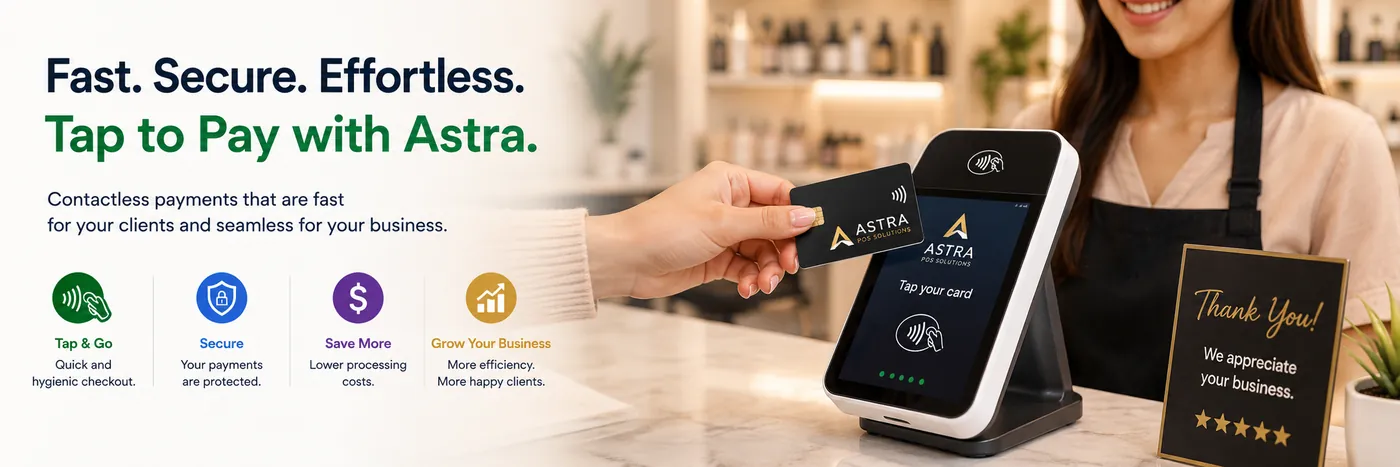
What flat-rate pricing is, how it compares with interchange-plus and tiered pricing, and the math on what a nail salon pays at $20,000, $50,000 and $100,000 a month in card sales.
Credit card processing is a bill most nail salon owners pay every month without ever checking it closely.
It comes out of your deposits automatically, the statement is hard to read, and the rate you were quoted when you signed up is rarely the rate you actually pay. But small differences add up fast. A gap of 0.8 percentage points sounds like nothing. On $50,000 a month in card sales, it is $400 a month, or $4,800 a year.
This guide explains how flat-rate credit card processing for nail salons works, how it compares with the other common pricing models, and how to work out what your salon really pays. Astra POS publishes this article and sells salon processing, so our own offer is kept in clearly labeled sections. Every rate we quote for another provider links to that provider’s own pricing page.
Flat-rate processing charges one fixed percentage on the card sales you process. To compare any two offers, use your effective rate: total processing fees ÷ total card sales × 100. A salon with a 2.60% effective rate on $50,000 a month pays $1,300. At 1.80%, the same month costs $900, a difference of $4,800 a year.
Flat-rate processing means you pay the same percentage on every card sale, whatever card the client uses. A Visa debit card, a premium rewards card and an American Express card all cost the same rate.
Here is what that looks like on a normal nail salon ticket:
Notice the tip. When a client adds the tip to the card, the processing fee is charged on the full amount, tip included. For a salon where most tips go on the card, that is a real part of the monthly bill.
Many well-known “flat-rate” offers are really two charges: a percentage plus a fixed amount on every transaction, such as 2.6% + 15¢. That fixed amount hits small tickets hardest, and nail salons run a lot of small tickets.
Here is what a 2.6% + 15¢ price works out to as a single effective rate at different average tickets:
| Average ticket | 2.6% of the ticket | Plus 15¢ | Effective rate |
|---|---|---|---|
| $25 | $0.65 | $0.80 total | 3.20% |
| $40 | $1.04 | $1.19 total | 2.98% |
| $50 | $1.30 | $1.45 total | 2.90% |
| $75 | $1.95 | $2.10 total | 2.80% |
| $100 | $2.60 | $2.75 total | 2.75% |
A salon that sells a lot of polish changes, fills and quick add-ons will see an effective rate well above the headline percentage.
Two offers can both be called flat-rate and still cost very different amounts. Before you compare, check whether the offer:
There is no single rate that every nail salon pays. What you pay depends on your pricing model, how cards are accepted (tapped, dipped or keyed in), the mix of cards your clients use, your volume and your account terms. Most of the cost comes from the percentage, but per-transaction fees and monthly account fees can add a meaningful amount.
Some providers publish their prices, which makes them useful reference points. These are standard published U.S. rates, checked on each provider’s official pricing page on October 12, 2026:
| Provider and plan | In person (tap, dip, swipe) | Keyed-in or card on file | Plan fee |
|---|---|---|---|
| Square Free | 2.6% + 15¢ | 3.5% + 15¢ | $0 a month |
| Square Plus | 2.5% + 15¢ | 3.5% + 15¢ | $49 a month per location |
| Square Premium | 2.4% + 15¢ | 3.5% + 15¢ | $149 a month per location |
| Stripe (standard pricing) | 2.7% + 5¢ (Terminal) | Online 2.9% + 30¢, plus 0.5% for manually entered cards | None listed for standard pricing |
| Clover | Rates and plan fees depend on the plan and on the bank or reseller that sells Clover. Ask for the full quote in writing. | ||
Rates change. Confirm the current price on the provider’s site before you decide. Links to each source are listed at the end of this article. These published rates are reference points, not a promise of what any particular salon will be offered or pay.
A card that is tapped, dipped or swiped at the front desk is a card-present transaction. It is lower risk, so it is usually priced lower. A card number typed in by hand, or a saved card charged later, usually costs more. In a nail salon that often means phone deposits and no-show or cancellation fees. If you key in a lot of cards, check that rate as carefully as the headline rate.
Look past the percentage. Common extras on processing statements include monthly statement or account fees, batch fees, PCI compliance or non-compliance fees, “regulatory” fees, chargeback fees, equipment leases and early termination fees. Some salons pay none of these and some pay several. Your statement is the only place to find out.
Flat-rate pricing is the simplest to understand, interchange-plus can be the most transparent, and tiered pricing is usually the hardest to check. Which one costs less depends on your salon’s actual numbers.
It helps to know what sits underneath every model. Each card sale carries an interchange fee, which goes to the bank that issued the client’s card. The card networks publish these rates. Mastercard, for example, explains that its interchange rates vary by card product and other qualifying criteria and are typically updated twice a year. Your processor then adds its own markup. The pricing model is simply how that total is packaged and shown to you.
| Flat-rate | Interchange-plus | Tiered | |
|---|---|---|---|
| How it’s priced | One fixed percentage, sometimes with a per-transaction fee | The actual interchange for each card, plus a fixed processor markup (for example, interchange + 0.30% + 10¢) | Each sale is sorted into a “qualified,” “mid-qualified” or “non-qualified” tier, each with its own rate |
| Predictability | High. Volume × rate gives you the bill | Medium. Changes with your card mix each month | Low. Depends on how the processor sorts each card |
| Transparency | Easy to check, but the processor’s margin isn’t shown separately | High, if the statement lists interchange line by line | Low. The processor decides which tier each card falls into |
| Possible extra fees | Per-transaction fees, keyed-in rates, monthly or PCI fees, depending on the provider | Monthly, batch, statement, PCI and network fees are common | Monthly, batch, statement and PCI fees are common, plus downgrades to higher tiers |
| Advantages | Simple. Easy to budget. Rewards cards and Amex can cost the same as debit | Can be the lowest cost for high-volume merchants with good terms | The “qualified” rate in the sales quote looks low |
| Disadvantages | You can pay more than cost on cheaper cards, like regular debit | Statements are long. The markup and extra fees are where costs hide | Many cards end up in the more expensive tiers. Hard to compare with other offers |
| May suit | Salons that want one number they can check every month | Larger salons that can read detailed statements, or have someone who does it for them | Rarely the best choice for a salon that wants clarity |
No model wins in every case. A high-volume salon with mostly debit cards and a well-negotiated interchange-plus markup may pay less than a flat rate. A salon whose clients use a lot of rewards cards and Amex may pay less on a flat rate. That is why the only fair comparison is total cost: your card mix, your volume, your fees and your contract terms, added up from real statements.
At a 1.80% flat rate, $50,000 in monthly card sales costs $900 in processing. At an effective rate of 2.60%, the same month costs $1,300. That is $400 a month, or $4,800 a year.
| Monthly card volume | Astra at 1.80% | Example at 2.60% | Monthly difference | Annual difference |
|---|---|---|---|---|
| $20,000 | $360 | $520 | $160 | $1,920 |
| $50,000 | $900 | $1,300 | $400 | $4,800 |
| $100,000 | $1,800 | $2,600 | $800 | $9,600 |
About the 2.60% figure: it is an illustrative effective rate chosen for comparison. It is not the verified rate of Square, Clover or any particular provider. Your own effective rate may be higher or lower. Astra’s 1.80% is available to qualifying nail salon merchants, subject to application and approval.
The per-transaction fee matters here too. For reference, Square’s published Free plan in-person price of 2.6% + 15¢ works out to about 2.90% at a $50 average ticket. On $50,000 a month, that is about $1,450. We walk through that comparison line by line in our nail salon POS system guide.
Enter your monthly card volume and your current effective rate. Don’t know your rate? Enter last month’s total processing fees and we’ll work it out.
Add your current effective rate, or last month’s total fees, to see the difference.
Estimates only. Results are not a quote and are not guaranteed savings. Actual costs depend on your card mix, how cards are accepted, merchant approval and your processing agreement. Astra’s rate is confirmed in writing before you sign up, and items billed separately, such as the annual PCI compliance fee, are listed in the flat-rate processing disclosures.
Effective rate = Total processing fees ÷ Total card sales × 100
Use a full month, and include every fee on the statement, not only the rate. If your statement shows $1,420 in total fees on $48,000 in card sales, your effective rate is 1,420 ÷ 48,000 × 100 = 2.96%. Check two or three months, because the number moves with your card mix.
A low rate saves money on every sale. Integrated payments save time and mistakes on every ticket. When the card terminal is a separate box from your salon software, someone has to make the two agree: re-typing totals, matching tips to technicians and fixing the end-of-day count when it doesn’t balance.
When processing is part of the salon system, each payment is attached to the ticket it paid for. That connects it to:
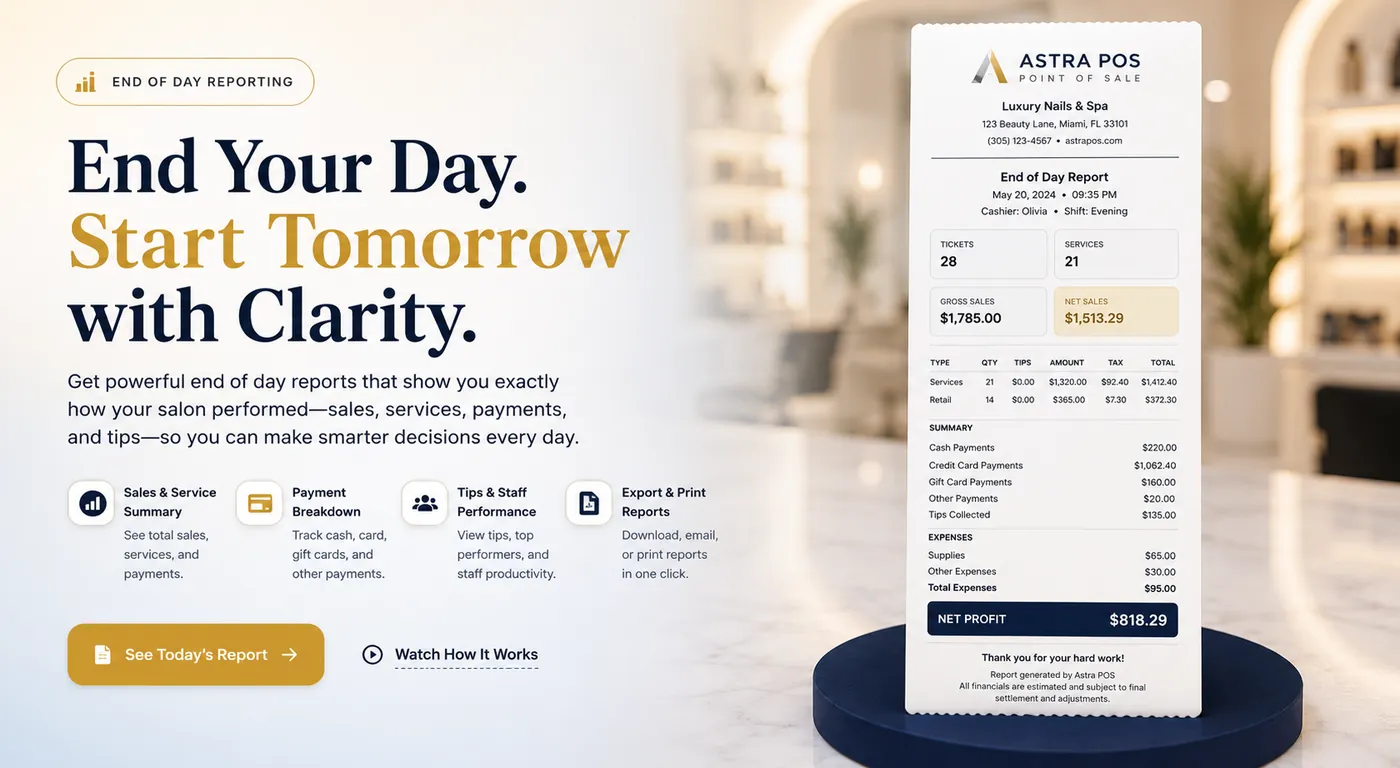
Astra POS was built this way: salon credit card processing runs inside the same system that handles the turn queue, check-in, booking, payroll and reporting. If you’re comparing systems, our guide to what a nail salon POS system should do covers the operations side in detail.
Ask for answers in writing, and compare them against your last few statements.
For more ways to cut costs on your current setup, see how to reduce credit card fees.
About our offer
Astra POS works with nail salons and beauty businesses across the United States, including many Vietnamese-owned nail salons. Our team supports owners and technicians in English and Vietnamese, from setup and training to day-to-day questions.
For qualifying nail salon merchants on this program
The 1.80% rate is subject to application and approval, and not every salon will qualify. Your rate and terms are confirmed in writing before you sign up. An annual PCI compliance fee of $99 is billed separately, and other conditional fees are listed in the flat-rate processing disclosures.
Beyond the rate, what we offer is help. Send us a recent statement and we’ll go through it with you line by line: what you paid, where it went and what the same month would have cost at a flat rate. If your current setup is already a good deal, we’ll tell you that too. Read more about our flat-rate processing program.
A good rate is one where your total effective rate, with every fee included, is low and easy to check. Many published card-present prices for small businesses fall between about 2.4% and 2.7% plus a per-transaction fee, and that per-transaction fee can push the effective rate toward 3% on smaller nail salon tickets. Compare your own effective rate against written offers, not against headline rates.
For many nail salons, yes. It makes your processing bill predictable and easy to check, and rewards cards and Amex can cost the same as any other card. It is worth it when the flat rate is competitive with your current effective rate and doesn’t come with extra fees that cancel out the difference.
Sometimes. Some terminals can be reprogrammed for a new processor and others are locked to the original provider or leased. Ask any new provider to confirm in writing. Astra POS supports a range of payment terminals and offers a terminal trade-in program.
Usually, yes. With Astra’s flat rate, debit, credit, rewards and American Express cards are all charged the same percentage. Other providers’ flat-rate plans may treat some cards or transaction types differently, so check the terms.
Look for the discount rate or percentage, per-transaction fees, monthly or statement fees, batch fees, PCI compliance or non-compliance fees, regulatory or network fees, chargeback fees, equipment lease payments and any annual fees. Add them all together to get your true cost.
Divide your total processing fees for the month by your total card sales for the month, then multiply by 100. For example, $1,420 in fees on $48,000 in card sales is a 2.96% effective rate. Use the calculator above to do it for you.
Yes. Our team reviews your current statement with you, explains what you pay now, confirms your Astra rate in writing, and helps with setup, hardware and training, in English or Vietnamese.
See what your salon could save on credit card processing. Send us a recent statement for a free review, or book a demo and we’ll walk through your numbers together.
Prefer to talk? Call 470-406-8485. Please don’t send full card numbers or client payment details. We only need your statement totals and fees.
Astra POS publishes this article, and Astra POS processing is our product. The processing figures are examples for illustration and are not a guarantee of savings. The 1.80% flat rate is offered to qualifying nail salon merchants, is subject to application and approval, and is confirmed in writing before you sign up. Third-party rates are taken from each provider’s published U.S. pricing on the date shown and may change.
This article is general information, not legal, tax or financial advice.
Sources (checked October 12, 2026; pricing changes, so check for updates):
Flat-rate processing built into the same system that runs your turn queue, check-in, booking, payroll and reporting.