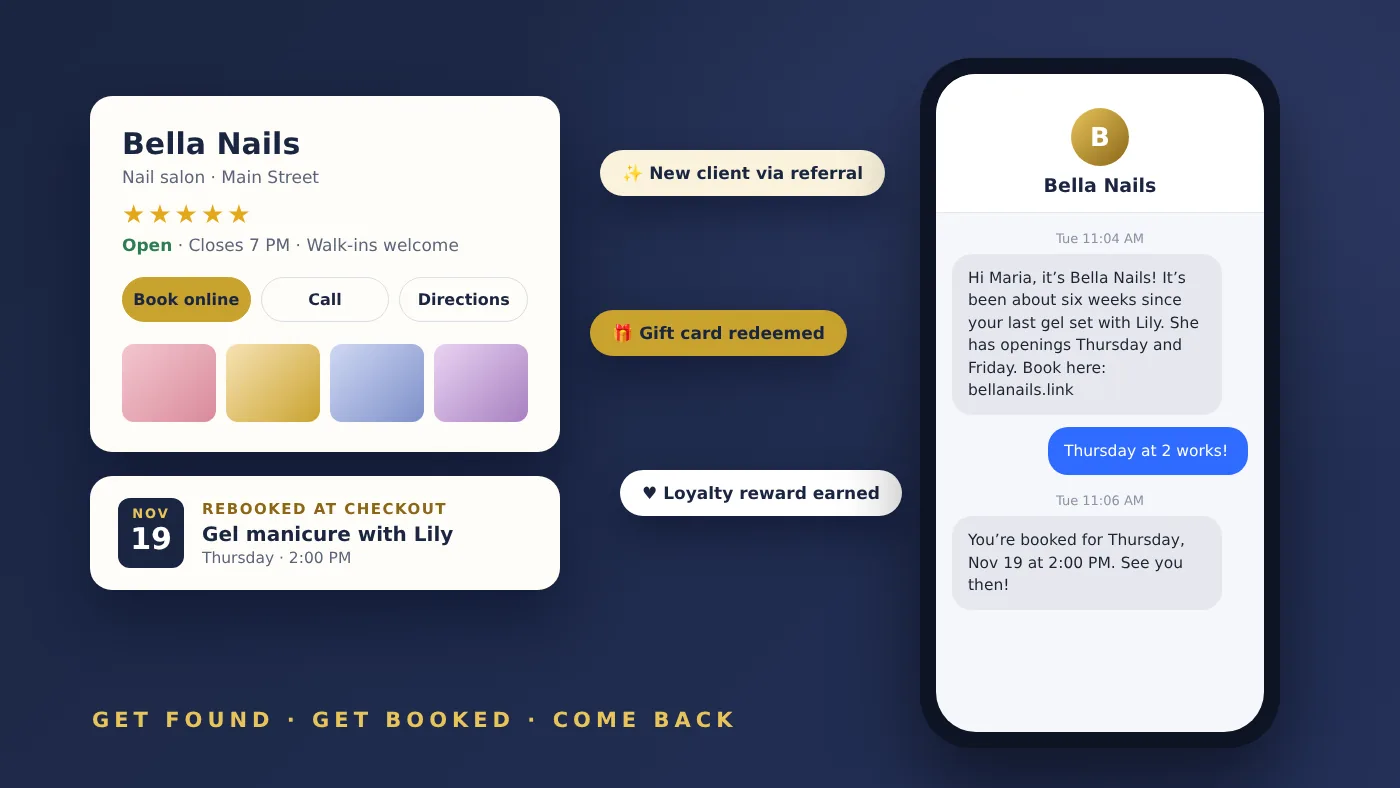
Twelve practical ways to get found on Google, fill your appointment book and bring clients back, most of which cost time rather than a big advertising budget.
Running a successful nail salon takes more than beautiful manicures and pedicures. Even talented technicians can struggle when the appointment book thins out, walk-in traffic drops, or first-time clients never come back.
The good news: growing a nail salon rarely starts with a big advertising budget. Most of the customers you need are already searching for a salon near them, scrolling past your posts, or sitting in your client list waiting for a reason to return. Whether you run a small neighborhood shop or a busy salon with a dozen technicians, the 12 strategies below will help you get found, get booked, and get clients to come back.
How to show up on Google Maps, turn followers into bookings, run referral and win-back campaigns that don’t eat your margin, fill slow weekdays, and measure which marketing actually brings paying customers. A ready-to-use 30-day plan and printable checklist are at the end.
When someone types “nail salon near me” or “gel manicure” into Google or Google Maps, the salons in the map results get most of the attention. Your Google Business Profile is what decides whether you appear there and whether people choose you once you do. For many salons it is the single most valuable free marketing tool they have.
Google says local results are based mainly on relevance (how well your profile matches the search), distance (how close you are to the searcher) and prominence (how well known you are, including your reviews). You can’t pay Google for a better local ranking, but you can make your profile as complete and active as possible:
Reviews matter for both ranking and trust, so make asking for them part of checkout. Our guide to getting more Google reviews covers simple ways to ask without being pushy.
A salon in a busy suburban shopping center adds its neighborhood and nearby landmarks to its business description (“next to the grocery store on Main Street”), lists every service with a starting price, uploads ten recent photos of gel and acrylic sets, and links its booking page. Over the next few weeks it posts one new photo a week and replies to each review within a day. None of this costs money; it simply gives Google and nearby customers more reasons to pick that salon.
Many clients think about their nails at 10 p.m., not during business hours. If the only way to book is to call while you are busy with a client, some of those people will simply book somewhere else. Online booking lets them reserve a time whenever it suits them.
It helps the salon too. Fewer phone calls interrupt technicians mid-service, appointments land in the schedule without being re-typed, and clients pick the service and technician themselves. A few things make the difference:
Our article on how salon online booking works walks through the full journey from a Google search to a confirmed appointment, and why appointment booking matters covers how to balance bookings with walk-ins.
Astra POS includes online appointment booking on the Astra Pro plan: each salon gets its own booking link, and appointments arrive directly in the salon’s schedule.
See How Astra POS Online Booking Works
Nails are visual, which makes social media a natural fit. People choose a nail salon with their eyes: a feed full of clean, well-lit work does more selling than any ad copy. You don’t need to be everywhere. Pick the one or two platforms your clients actually use and post consistently.
Every post should make the next step obvious: put your booking link in your bio and mention it in captions.
A recommendation from a friend is one of the most trusted ways a new client finds a salon. A referral program simply gives your happy clients a reason to make that recommendation and gives the new client a reason to act on it.
Keep it simple: “Refer a friend and you both get $5 off an eligible future service.” Both people win, the reward is easy to explain at the front desk, and it only costs you when a new client actually shows up and pays.
A referred client books a $45 gel manicure. The salon gives $5 off to the new client and $5 off to the referrer: $10 total. If that new client comes back every three weeks, she could spend roughly $700–$800 a year at the salon. Even if only some referred clients become regulars, a $10 reward is a small price for a new client. These numbers are an example, not a prediction; use your own prices and return rates.
Getting more customers doesn’t help much if booked clients don’t show up. Every empty chair during a booked slot is time your technician can’t sell to someone else. A few habits protect that revenue:
For the details, see how to reduce no-shows at your salon, our guide to salon appointment text reminders (including what to say and when to send), and our free nail salon deposit policy template.
The easiest appointment to book is the next one, made while the client is still admiring her nails at the front desk. Rebooking before she leaves turns “I’ll call you” (which often never happens) into a confirmed visit.
Typical maintenance intervals give staff a natural reason to suggest a date. They vary by client and product, but as a general guide:
| Service | Common rebooking window |
|---|---|
| Acrylic or hard gel fills | About every 2–3 weeks |
| Gel manicure | About every 2–3 weeks |
| Dip powder | About every 3–4 weeks |
| Regular manicure | About every 1–2 weeks |
| Pedicure | About every 3–6 weeks |
Front desk: “These came out beautiful. Gel usually looks best for about two to three weeks. Want me to save you a spot with Lily on the 21st, same time?”
Client: “I’m not sure about my schedule yet.”
Front desk: “No problem, I’ll put you down and you’ll get a reminder. If it doesn’t work, you can move it from the link anytime.”
The key is to offer a specific date and technician rather than asking “Do you want to book again?” For clients who prefer to decide later, hand them a card or text with your booking link. Our guide to turning first visits into loyal regulars has more ideas.
Astra POS brings online booking, client records with visit history, checkout and daily reports into one system built for nail salons, so the front desk spends less time on paperwork and more time with clients.
Winning back a past client is usually easier than finding a brand-new one: she already knows where you are and has sat in your chair. The challenge is noticing she has drifted away before she settles in somewhere else.
“Hi Maria, it’s Bella Nails! It’s been about six weeks since your last gel set with Lily. She has openings this Thursday and Friday. Book here: [link]. Reply STOP to opt out.”
“Hi Jen, we miss you at Bella Nails! Come back for a pedicure this month and enjoy a free paraffin treatment on us (Mon–Wed visits). Book: [link]. Reply STOP to opt out.”
Your client records are what make this work. With Astra POS customer management (Astra Core and higher plans), owners can open any client and see their visit history, which makes it easy to spot regulars who have gone quiet and reach out with the right message.
Loyalty programs give regulars a reason to keep choosing you instead of trying the new salon down the street. The best ones are simple enough for a client to understand in one sentence.
Our guide to salon loyalty programs compares points, visits and tiers in more detail. Astra POS includes a loyalty program on the Astra Pro plan.
Gift cards are one of the few marketing tools where someone else pays to bring you a new customer. Every card a regular buys for a friend, sister or coworker is an introduction to someone who may never have visited otherwise.
Under federal gift card rules, gift card funds generally can’t expire for at least five years, and inactivity fees are restricted, so set your terms accordingly. Our article on salon gift cards covers how to run a gift card program, and Astra POS includes gift cards on the Astra Pro plan.
Most nail salons are packed on Friday and Saturday and quiet earlier in the week. You are paying rent and staff either way, so filling those slower hours is close to pure profit, as long as the promotion doesn’t simply give away margin to clients who would have come anyway.
“Treat Yourself Tuesday & Wednesday”: book any gel manicure plus spa pedicure on Tuesday or Wednesday and get a free paraffin treatment and nail art on two accent nails. Valid for appointments before 4 p.m. this month. The add-ons cost the salon little, the offer fills chairs on the slowest days, and the regular weekend prices stay untouched.
For more ways to raise what each visit is worth, see how to increase salon revenue.
Likes and followers feel good, but they don’t pay rent. The question that matters is: which marketing actually brings in paying clients, and which of those clients come back? Once you know that, you can spend more on what works and stop what doesn’t.
| Channel | Typical cost | Best for | What to measure |
|---|---|---|---|
| Google Business Profile | Free (your time) | People ready to book nearby | Calls, booking-link clicks, new clients who say “Google” |
| Social media | Free to post; ads optional | Showing your work, staying top of mind | Bookings from bio link, clients who say “Instagram” or “Facebook” |
| Referrals | Reward cost only when it works | High-trust new clients | Referred clients, how many return |
| Text messages | Low per message | Reminders, rebooking, win-backs | Bookings within a week of a message, opt-out rate |
Here is an illustrative monthly budget for a small salon. These are example numbers, not a recommendation or a guaranteed result; every market is different.
| Marketing activity | Monthly budget |
|---|---|
| Local social media advertising | $150 |
| Referral incentives | $75 |
| Promotional materials (flyers, QR cards) | $25 |
| Total | $250 |
To find your customer acquisition cost, divide what you spent by the number of new paying clients it brought in:
If those clients come back regularly, $10 is an excellent investment. If most never return, the real cost per lasting client is much higher, which is why tracking repeat visits matters as much as tracking first visits.
Trying all twelve ideas at once usually means none of them get done well. Spread them over a month, one focus per week, then keep what works.
Complete your Google Business Profile, add photos and your booking link, and make sure online booking works on a phone.
Post three times on your main social platform and launch a simple referral offer at the front desk.
Contact clients who haven’t visited in 30–60 days (with consent) and start promoting loyalty and birthday rewards.
Count new clients by source, check rebooking and no-show rates, and put more effort into the best-performing channel.
Start with the free basics: a complete Google Business Profile with photos, reviews and a booking link, online booking that works on a phone, and consistent social media posts of your work. Then focus on keeping the clients you get through rebooking, reminders, loyalty rewards and referrals.
For most salons, the best-performing “advertising” is a strong Google Business Profile, because it reaches people already searching for a nail salon nearby. Paid social ads targeted to your local area can add to that. Whatever you try, track how many paying clients each channel brings.
Optimize your Google Business Profile, ask every happy client for a review, post your work on Instagram, Facebook or TikTok, rebook clients before they leave, and ask regulars to refer friends. These cost time rather than money.
Set up your Google Business Profile before you open, collect early reviews from your first clients, post photos of your space and work, offer an opening referral reward, and introduce yourself to neighboring businesses. If you are just starting out, see our guide on how to open a nail salon.
Make the salon easy to spot and easy to say yes to: clear signage, a visible “Walk-ins welcome” sign, accurate Google hours, and a short wait when people arrive. A smooth walk-in process matters too; see nail salon walk-in management.
Offer a specific next appointment at checkout, send reminders, reach out to clients who haven’t visited in 30–60 days, and reward loyalty with points, visit rewards or birthday offers. Consistent quality and friendly service matter most of all.
There is no single right number. Many small salons start with a modest monthly budget, such as a few hundred dollars, and adjust based on results. What matters most is knowing your cost per new client and whether those clients return.
It can. Online booking lets clients reserve a time outside business hours and from your Google profile or social pages, without calling. It also reduces phone interruptions for your team.
If you only do three things this week, make them these: finish your Google Business Profile, put your booking link everywhere clients look, and ask every client at checkout for a review and a next appointment. Those three habits support everything else in this guide.
When you’re ready to look at the system behind it all, our nail salon management software guide explains what to look for, and our comparison of the best POS systems for nail salons puts the main options side by side. If you’d rather hand the marketing off entirely, Astra also offers done-for-you salon marketing services.
Sources: Google Business Profile Help, “How to improve your local ranking on Google”; Federal Communications Commission TCPA rules on consent and opt-outs for marketing texts, summarized in “The TCPA’s new opt-out rules” (Bryan Cave Leighton Paisner); Federal Reserve, “Final rules on gift cards.”
This article is general marketing guidance for U.S. nail salons, not legal advice. Budget, referral and revenue figures are illustrative examples, not guaranteed results. Text message marketing and gift card rules can vary by state; check the rules that apply to your salon. Astra POS features are listed by plan on our pricing page.
From online booking and customer management to technician scheduling and reporting, Astra POS helps salon owners simplify daily operations so they can focus on their customers.